
Find Out Who Owns a Dade County Property
A set order makes the search easier. Start with the street address in the county-linked assessor or tax search. Write down the parcel number. Note the taxpayer or owner name the roll displays, then test that identity against the newest recorded deed. Each system answers a different part of the question. The roll is a working annual record, while the deed establishes the recorded transfer itself.
- Search the address through the Dade County Board of Tax Assessors qPublic link or the Tax Commissioner's AssuranceWeb portal.
- Copy the parcel or PIN, physical address, record year, and exact name shown.
- Search the grantee name in the Clerk of Superior Court property index and identify the most recent deed.
- Match parcel clues, legal description, and book/page before treating the records as the same land.
Dade County Owner Clues in the Tax Search
Dade County's AssuranceWeb tax search accepts Name, Bill Number, Company, Parcel, Account, and Address. That range of fields makes it a strong entry point. Results carry labels such as FullName, PhysAddress, parcel, PIN, account, tax year, billing year, bill number, due date, total tax, and balance due. The labels link an address to an account cleanly. The returned name is what the portal shows. It is not certified title.
A physical address tells where the parcel sits. It is not necessarily where notices go. Dade County owner research should preserve the exact field label, the year, and the parcel key. Merging a situs address with a presumed mailing address is a common and costly error.
Sources That Identify a Dade County Property Owner
No single source answers who owns this property in Dade County. Each record plays a role. The tax or assessment roll locates a name and parcel, the deed index traces the latest recorded transfer, and the parcel layer supplies map context. Attach the source and access path to every conclusion.
| Source | Owner Info It Gives | Access |
|---|---|---|
| qPublic and AssuranceWeb | Assessment or taxpayer name, parcel keys, address, and record year | County-linked online search or assessor office |
| Clerk property index | Grantor, grantee, instrument type, recording date, and book/page | Current Kofile route, GSCCCA, or Clerk counter |
| Georgia business search | Entity filings and registered-agent details when an LLC owns land | Secretary of State online search |
| SIB_Parcels service | Reference geometry tied to deed and legal-description data | ArcGIS REST layer and its Map Viewer link |
The owner of record is not the occupant. A parcel may sit inside a trust, an estate, or a business. A tax-related name can reflect a role different from the grantee on the latest deed. Always confirm the capacity.
Trace the Roll Name to Dade County's Latest Deed
The GSCCCA real-estate name form narrows by grantor or grantee, instrument type, county, party name, and recording dates. Search the roll name as a grantee first. Then compare the newest plausible result with the parcel's legal description and book/page. Try spelling variants if no match appears.
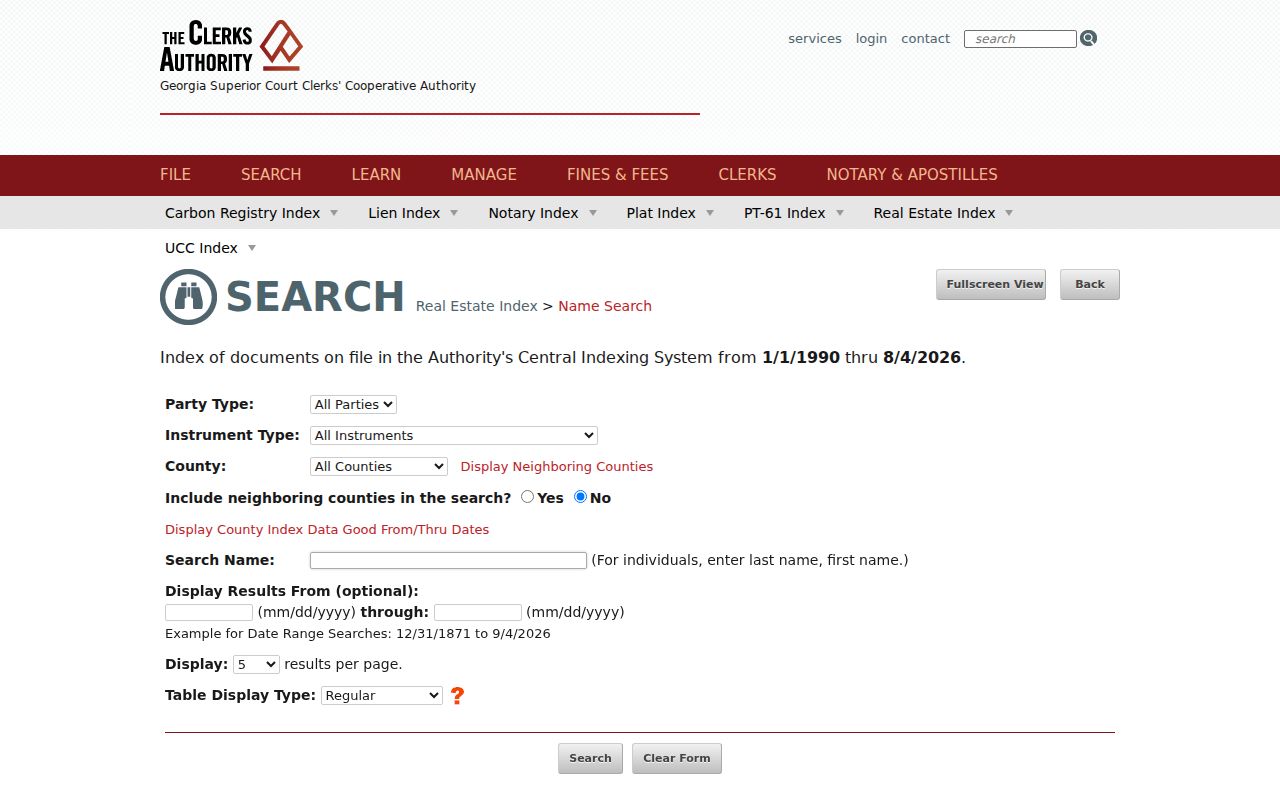
An index row only points toward an instrument. A deed image or certified Clerk copy is the stronger proof, because it shows the named parties and the legal description together.
Identify a Dade County LLC or Estate Owner
A business owner calls for one extra step. Search the exact entity spelling in the Georgia Corporations Division database. Compare the control number, filing date, principal-office details, and registered agent. A registered-agent address is a contact point alone. It is not the parcel address, and it does not prove the agent owns the land.
Estates and trusts read differently. Probate orders, executor deeds, deeds from an estate, and trustee language can explain why a family surname disappears from the roll. The Clerk's instrument menu includes estate documentation.
- Owner of record
- The person or entity named by the relevant official ownership record.
- Grantee
- The party receiving the interest in a recorded deed.
- Vesting
- The words that state who holds title and in what capacity.
- Situs address
- The physical location of the land, which may differ from a mailing address.
Use Parcel and Description Clues to Resolve a Conflict
Disagreement between two official views is common. Compare their dates and roles first. A tax year, an assessment snapshot, a deed recording date, and a GIS layer date measure different events. Next, match the parcel or PIN, legal description, acreage, and book/page. A matching surname alone proves little.
Dade County's ArcGIS service draws ownership boundaries tied to legal descriptions and deeds, and its public metadata lists no owner field for the live parcel. Use the map as a locator. If the disagreement matters to a purchase, estate, or boundary issue, ask the Clerk for the recorded instrument and consult a title professional where needed.
Current and Historic Dade County Systems Split at 1997
Dade County's records split at 1997, but not cleanly. The Clerk runs a current property search. A separate Kofile historical search covers 1849 through 1997. The GSCCCA form displays a 1990 through August 4, 2026 range, and GSCCCA says its central index includes every county since at least 1999. Those systems load differently, so treat the cutoffs as separate facts rather than one line.
Crossing 1997 means checking both digital doors. Keep the book/page citation close. Older deeds may sit at the Clerk counter, in courthouse books, on Georgia Archives microfilm, or within FamilySearch, and a blank screen never proves the record is missing.
Dade County Ownership Alerts Add a Timely Check
Georgia's filing-activity notification service, FANS.gsccca.org, is promoted by the Dade Tax Commissioner. It serves as a guard against an unauthorized ownership change. The alert itself decides nothing. An alert simply means something was filed, valid or not. A closer look at the instrument is warranted. If a filing is unfamiliar, inspect it and contact the Clerk directly.
That check matters once you have answered who owns a property. Deed records and tax roll entries can shift after a saved search. Keep the recording date and instrument reference with your notes. Before relying on an older answer, confirm the latest state of the property records index.
Reach Dade County Offices When a Portal Stops
Two offices can break a stalled search loose. The Dade County assessor at 71 Case Avenue maintains parcel records. Its published number is 706-657-6341. The Clerk at 255 W. Crabtree Street, Suite 103 handles recorded deeds, plats, liens, and similar instruments, reachable at 706-657-4778. When you call either office, have the street address ready. Also have the parcel or PIN, the exact displayed name, the date span, and any book and page you already turned up. Staff work fastest with specifics.
Dade County also takes Open Records requests for material the portals do not carry. Send the county form, email info@dadecounty-ga.gov, or deliver it to 71 Case Avenue, Suite 243. Mail works too. Request an existing record, not a custom ownership report. Georgia law generally requires production within three business days or a written timetable. The first 15 minutes of search time are free. The county may bill reasonable direct costs.
Keep a Dade County Ownership Evidence Packet
Build an evidence packet as you go. Write down the URL, the date you checked, and the tax or assessment year. Note each field label too. Record the name, address, parcel or PIN, and account. For the deed, add party roles, instrument type, recording date, and book/page. The packet shows exactly how you reached the property owner answer. It also lets anyone repeat the work later, after the property records change.
Some situations demand more than a web result. For a purchase, estate dispute, suspected fraud, or another legal issue, use certified Clerk records. Seek qualified advice as well. An online entry will not disclose every unrecorded interest. It cannot replace a title search. And an ArcGIS parcel line is never a stand-in for a recorded plat. It is no substitute for a boundary survey.
Limits on Who Owns This Property in Dade County
A public result has real limits. It may name a taxpayer, an assessed owner, or a deed grantee. It does not prove who lives at an address. It will not settle unrecorded claims, certify a complete title chain, or locate a legal boundary. Georgia law also protects Social Security numbers and financial data. It shields some officials' home information and Safe at Home substitute addresses. Agencies typically redact those protected fields and release the public remainder of the property records.
Lawful use. Use Dade County owner information for property diligence, estate work, or civic research, never to stalk, harass, threaten, or harm a person.