
What Dade County Deed Records Convey
Deeds, plats, condominium floor plans, liens, and UCC filings all pass through the Dade County Clerk of Superior Court. Identify the document type before anything else. A conveyance and a debt instrument can name the same parcel. Only one of them actually moves title.
| Deed Type | What It Does | Common Use |
|---|---|---|
| Warranty deed | Conveys the stated interest with title promises written into the instrument | An ordinary arm's-length transfer |
| Quitclaim deed | Conveys only the interest the grantor has, if any | Family, estate, or title-cleanup work |
| Security deed | Secures a debt against the described land | Financing rather than a stand-alone sale |
| Executor or trustee deed | Conveys through a fiduciary acting under legal authority | Estate or trust administration |
| Tax deed | Records a transfer arising from a tax-sale process | Distressed-property research that needs later checks |
A deed concerns ownership. A security deed or lien concerns a debt tied to the land instead. Pull the releases, cancellations, and later deeds along with the first filing. One record alone rarely finishes the story.
Dade County Deeds Begin with the Clerk
The Dade County Clerk of Superior Court real-estate office is the authoritative custodian. Visit at 255 W. Crabtree Street, Suite 103, Trenton, GA 30752, or call 706-657-4778. The office page lists current access and copy instructions. Confirm those details before any visit or mailed request.
Dade County Clerk of Superior Court
Holds: deeds, plats, condominium plans, liens, UCC records, the general execution docket, and military discharges.
Channels: online indexes, office counter, telephone guidance, and copy requests to the custodian.
The restored historic courthouse reopened as a landmark in 2025. Deed-copy work still runs through the Clerk's W. Crabtree Street office, though.
Two Digital Doorways for Dade County Deed Records
The Clerk's Property Index Search page splits its coverage in two. A historical Dade County system covers 1849 through 1997. The GSCCCA form picks up from 1990 and runs to the present. That overlap is a feature, not a flaw. Search both doorways whenever a chain of title crosses the 1990s. Compare recording date, parties, instrument, and book/page. Do that before treating two rows as the same filing. The official page displays the two routes side by side.
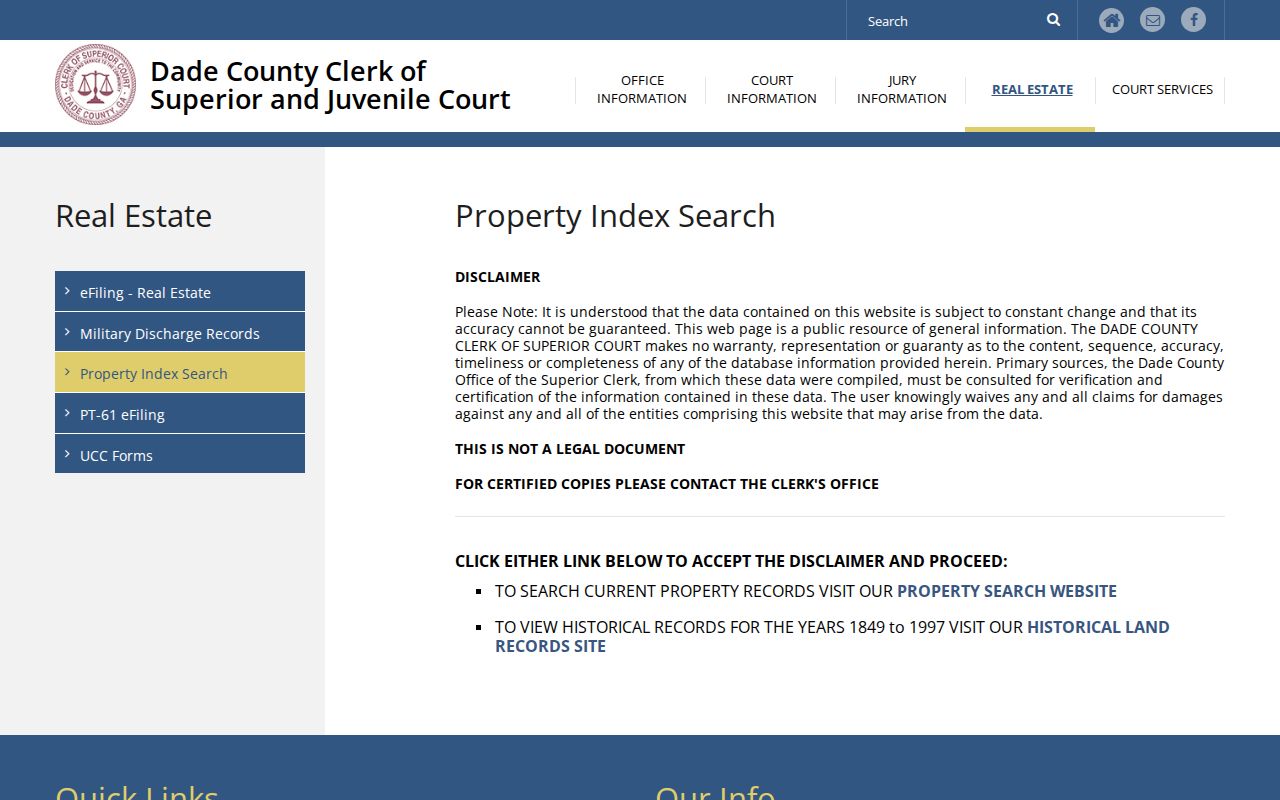
So a blank result in the current index is not the end of the road. Try the historical doorway before concluding no deed exists.
Fields That Narrow a Dade County Deed Search
The statewide GSCCCA real-estate index offers the most detailed search form. It accepts party role, name, instrument, county, date range, and result controls. Add limits for any short or common surname, since broad matches quickly bury the useful ones.
| Index field | How to use it |
|---|---|
| Grantor or grantee | Choose seller or giver for grantor; buyer or recipient for grantee |
| Last/entity and first name | Try initials, name variants, trusts, estates, and company names |
| County | Limit the search to Dade County, then widen only when a border issue calls for it |
| Instrument type | Separate deeds from security deeds, releases, liens, and other filings |
| Date range | Bracket the likely transfer or recording period |
| Book and page | Use a known citation to move straight toward the recorded document |
The GSCCCA name-search form is an index tool. Its summary points to a record; the certified instrument itself comes separately.
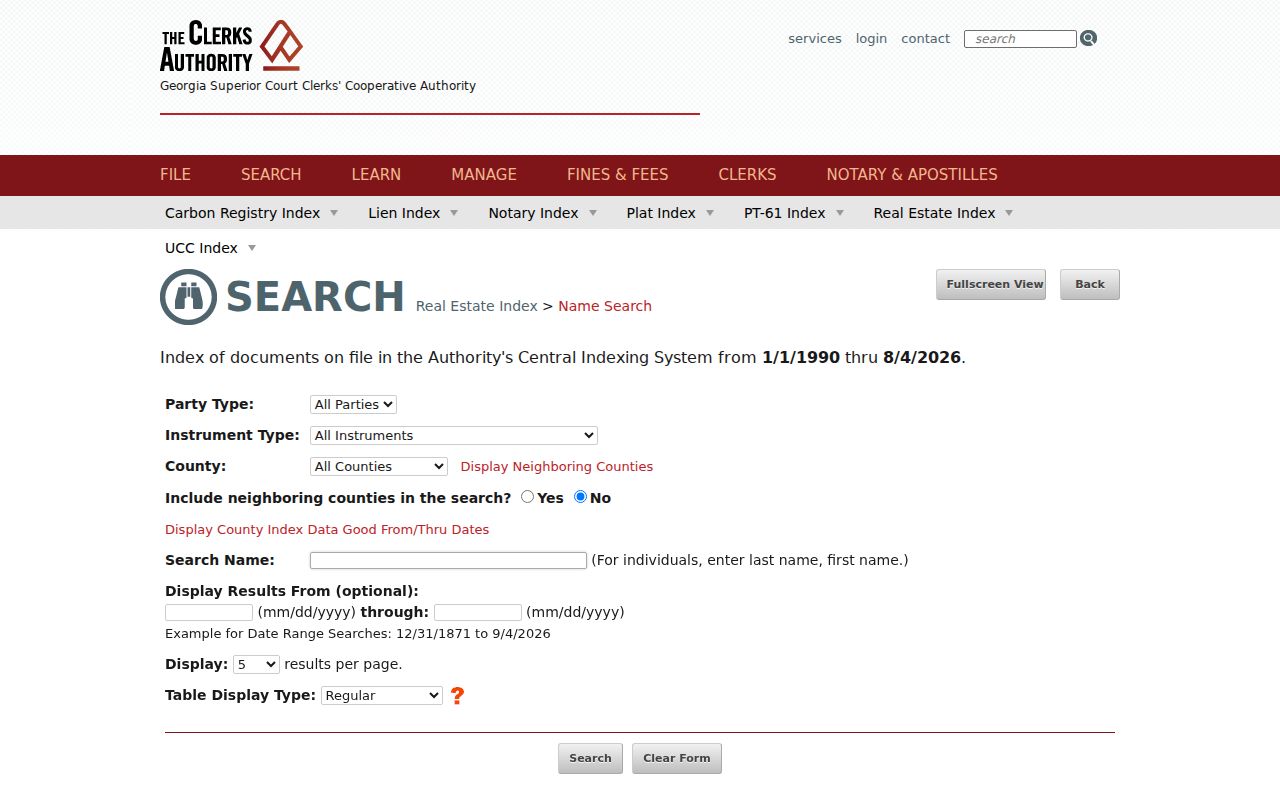
Write down every spelling and reference exactly as shown before moving to another system.
Walk the Dade County Grantor-Grantee Chain
A chain of title comes together one link at a time. Start with the newest credible deed for the parcel rather than a surname alone. Keep the legal description beside every index reference so people with similar names never merge into one.
- Find the present party's acquisition deed by searching that party as grantee.
- Record the grantor, date, instrument type, book/page, and legal description from that link.
- Search the grantor as a grantee in an earlier date range and confirm the same land.
- Repeat the process, switching to the 1849-1997 index, deed books, or microfilm when needed.
- Grantor
- The party conveying the stated interest.
- Grantee
- The party receiving that interest.
- Chain of title
- The linked sequence of recorded conveyances for the same land.
- Book/page and instrument number
- Recording references used to identify and retrieve a filing.
The 1849 Doorway into Older Dade County Deeds
The historical Dade land-record search covers 1849 through 1997. For earlier or missing material, turn to the Clerk's deed books, the Georgia Archives microfilm card catalog, and the FamilySearch county catalog. Each is a separate access channel. None replaces careful matching. Older land descriptions lean on land lot and district, acreage, lot and block, a subdivision name, a natural boundary, or adjoining owners. Some also cite Salem, the county-seat name that became Trenton in 1840. Record every clue exactly as written. A modern street address may not appear at all. When an index returns nothing for a name, test initials, spelling variants, married names, and entity forms. A trustee or executor can interrupt an otherwise simple surname trail. Follow any prior-deed reference printed inside the instrument. Compare the land description before linking it to the next owner of record. The Georgia Archives county microfilm catalog adds deed books, tax digests, and probate material when the county portals run dry.
Coverage checkpoint. The county-linked historical search begins in 1849; ask the Clerk or Archives where any earlier or unindexed book is held.
Dade County Courthouse Fires Do Not Prove a Deed Gap
Dade County reports courthouse fires in 1853 and 1863. A courthouse then stood in use from 1869 until its 1925 demolition. That history argues for checking multiple catalogs. It does not prove every deed book from those eras burned. No official inventory lists a specific lost-book range. A deed records search can still fail. Ask the Clerk or the Georgia Archives for an inventory before drawing conclusions. The honest answer is that the record was not in the channel searched. A gap is only real once it survives that check.
Security Deeds, Liens, and Releases in Dade County
A deed file tells more than who owns the land. Security deeds, liens, and releases sit alongside conveyances in the Dade County deed records. Search the owner or debtor name. Then match the parcel description, date, and recording reference on each instrument. A release or cancellation is filed as its own document. It usually points back to the security deed or lien it clears.
Fees apply to these filings. Under the Clerk's schedule effective July 1, 2024, a real-estate instrument, a lien or general execution, and a release, cancellation, satisfaction, or assignment each cost $25 to record. Those are recording charges only. They say nothing about the price of an online deed image. So confirm costs with the live schedule.
The legal description has to match. A release should cite the recording reference of the earlier instrument it clears. A security deed is not a later sale. A release is not a conveyance. Keeping those distinctions straight keeps the deed chain focused on real changes. It tracks the recorded ownership interest in Dade County.
Dade County Deed Alerts Add a Timely Check
Dade County offers an early-warning option for owners. The Tax Commissioner promotes FANS, a service that sends text or email notice of unauthorized changes to property ownership. Enrollment is quick. The service does not guarantee timing or coverage of every deed instrument, so treat any notice as a prompt rather than proof. An alert never blocks a filing. Confirm any unexpected notice against the recorded deed in the Clerk's records, then call the Clerk through an official number.
Request a Dade County Deed Copy
An online image works well for a first look at Dade County deed records. For a dependable copy request, give the Clerk the county, party names, instrument type, recording date, and book/page or instrument number. Ask about counter pickup, mail, or electronic delivery. Say whether you need certification.
Copy fees appeared in the July 1, 2024 schedule. An uncertified copy ran $0.50 per page without staff help, or $1 per page with help. A certified or exemplified copy cost $2.50 for the first page plus $0.50 for each added page. Electronic copies, faxes, and computer printouts carried separate charges. Check with the Clerk for current prices.
If the portal fails, call 706-657-4778 or visit the W. Crabtree Street office. Keep your written request narrow to save time. Broader county open-records requests can also go to 71 Case Avenue, Suite 243, P.O. Box 370, Trenton, or info@dadecounty-ga.gov. Deed copies should still go to their direct custodian first.
Recorded, not guaranteed. A Dade County index result shows a filed record, not clear title, and unrecorded interests may exist.