
Trace Back Dade County's Former Owners
Build the deed timeline in reverse. Enter each Dade County transfer as its own row, and carry the exact book and page into the next search, because the modern and historical property records systems overlap. Dates guide the next channel.
| Transfer Date | Grantor to Grantee | Deed Type | Book/Page |
|---|---|---|---|
| Newest located deed | Prior owner to current grantee | As indexed | Copy exact pointer |
| Previous transfer | Earlier owner to later grantor | Warranty or quitclaim, as shown | Copy exact pointer |
| Estate transfer | Representative to grantee | Estate deed or related record | Preserve case and deed clues |
| Historical-book link | Older grantor to grantee | Read original heading | Book and page control |
Start with the newest matching deed. For older Dade County deed records, expect to move from a name index into original deed books or microfilm.
Enter Dade County's 1849 to 1997 Historical Index
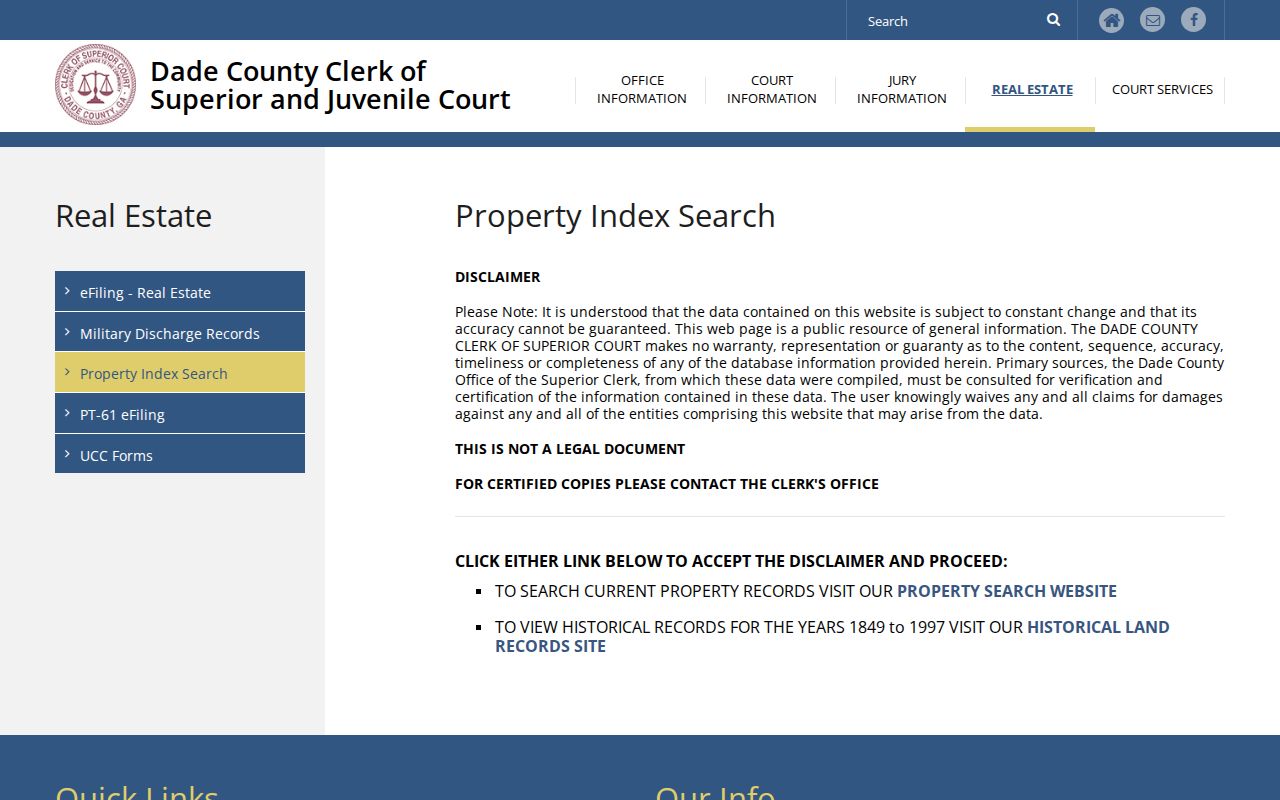
The Clerk's property-index page splits Dade County deed records between a current system and a Kofile historical collection covering 1849 through 1997. That split matters whenever prior-owner work crosses decades.
GSCCCA showed dates from 1990 through August 4, 2026, and its explainer notes that all counties appear from at least 1999 onward. Where those ranges overlap, it pays to check both systems.
Reconstruct the Dade County Deed Chain Backward
Prior-owner research reads names backward. The grantee on one Dade County deed is the party whose earlier deed you need, and the grantor marks the prior link in the property records chain.
- Locate the current acquisition deed and verify its legal description.
- Record grantor, grantee, deed type, recording date, and book/page.
- Search that grantor as a grantee to find the earlier acquisition.
- Repeat, then move to the historical index, deed books, or microfilm.
- Grantor and grantee
- The conveying party and receiving party named in an instrument.
- Chain of title
- The ordered sequence of recorded transfers affecting the tract.
- Reverse index
- A party-name route used to locate older instruments.
- Quitclaim and warranty deed
- Different deed types whose exact labels must be preserved.
Carry Dade County Book and Page Clues
A street address is a weak bridge. Dade County deeds may instead describe land by subdivision lot and block, land lot and district, acreage, metes and bounds, or natural features, so the book and page plus the legal description serve as the stronger anchors.
Follow that citation before any surname search. An older deed pointing to a prior instrument leads you straight to the next link in the chain.
Handle Dade County Estate Transfers
Surname chains break when Dade County land passes through probate, a trustee, or a representative. The Clerk index covers estate deeds. Search the decedent, the estate, and the representative. Also search heirs and any later grantee before concluding the trail is cold.
Tie each probate order to a recorded deed. The estate file shows who had authority. The deed supplies the parcel-specific link in the Dade County property records.
Search Salem When Trenton Fails
Dade's county seat was called Salem before the name changed to Trenton in 1840. Old deeds, directories, and tax digests say Salem. Keep the original wording. Search both names.
When an address vanished, compare acreage, land lot or district, adjoining owners, and legal calls rather than forcing the old record onto a modern Dade County map.
Continue Dade County Prior Owners Through Archives
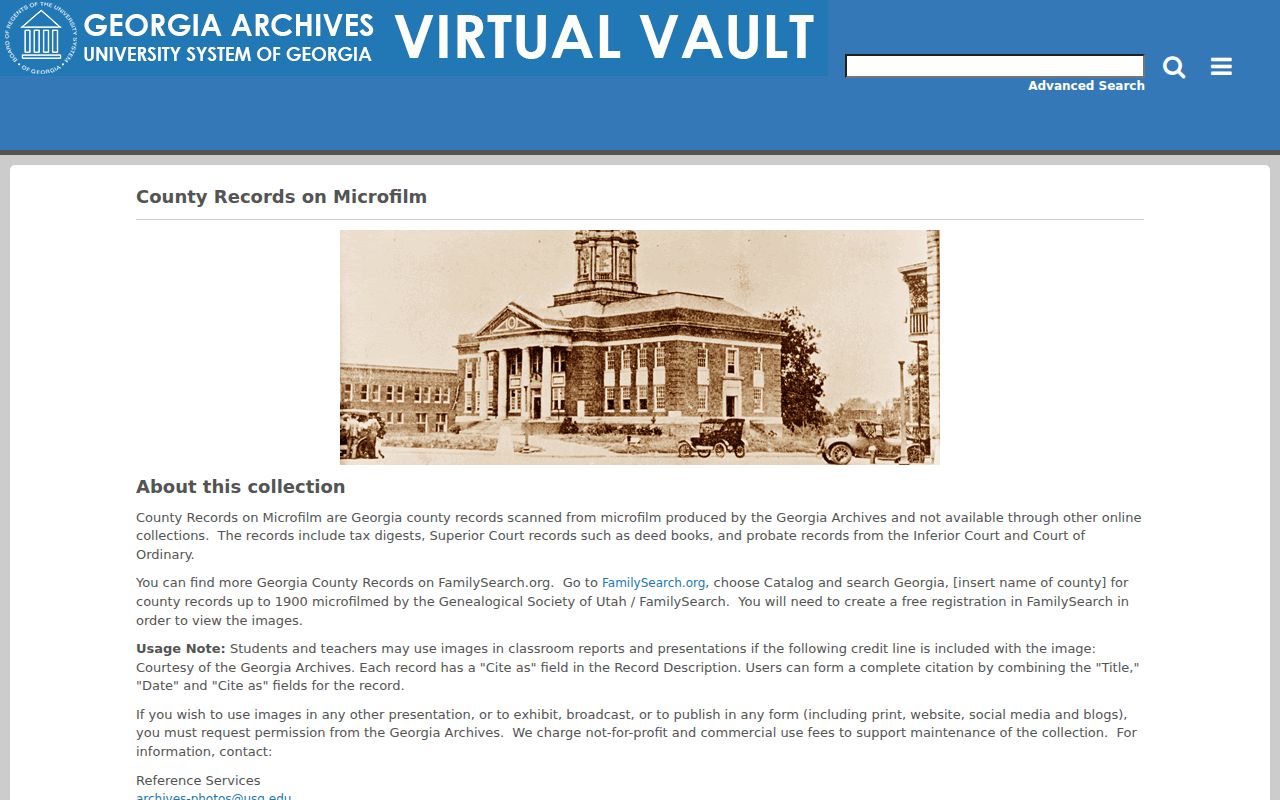
Georgia Archives points researchers to county microfilm holding Superior Court deed books, tax digests, and probate records. FamilySearch and the catalog supplement the Clerk counter. Not every image is online.
The Georgia Archives county microfilm collection is the fallback. Ask for the exact Dade County series, volume, and date span rather than a prior-owner compilation.
Read Dade County's Courthouse Fire Story Carefully
Dade County's courthouse history includes fires in 1853 and 1863, demolition of the 1869 building in 1925, and the courthouse that followed in 1926. Those events matter for physical records. No fire story names a missing deed-book run. Never invent a gap.
Ask the Clerk or the Archives which book, index, copy, or microfilm survives for the date in question.
Distinguish Deeds from Dade County Liens
Security deeds, releases, liens, easements, and boundary agreements sit between ownership transfers in the index. Dade County records these instruments alongside deeds. Keep them anyway. They explain the parcel's record history. But the instrument type and the full document decide each party's role. Not every named party actually held title.
A release cancels an earlier security interest. An easement can burden or benefit the tract without transferring the fee. A plat may fix a lot description without naming the later owner of record. Separate columns for ownership deeds and other instruments keep the backward chain clean. That keeps it from drifting into a list of everyone tied to the property.
Use Dade County Plats to Hold the Same Tract
Plats bridge the gaps. They connect lot-and-block language, road rights-of-way, easements, dedications, and restrictions in Dade County property records. Search the Clerk's plat records by subdivision, owner, legal description, or cited book and page whenever those clues appear. Rural land differs. Dade tracts outside town may instead rest on acreage, land lot and district, metes and bounds, or natural features.
A plat can prove two deeds share a lot. Later deeds, releases, and surveys may still change that picture, so for a boundary dispute get the recorded plat and deed and consult a Georgia-licensed surveyor; the parcel map is reference geometry, not a replacement for those instruments.
Ask Dade County Offices for Older Owners
The Clerk counter is the best offline stop for deed books, indexes, and plats. It also provides certified copies. Bring specifics. A book and page citation, party names, and an approximate date all help. The legal description helps too, and it lets the Clerk locate the right record. Fees vary by format. The published copy schedule sets separate charges for uncertified, assisted, certified, electronic, and computer printout copies. Confirm the current fee before ordering.
Records held outside the deed system take a different path. Dade's Open Records form, email to info@dadecounty-ga.gov, and mail all work. Delivery to 71 Case Avenue, Suite 243, also works. Name the record series and span. The Georgia Open Records Act generally requires production within three business days or a timetable. The government need not assemble a fresh chain-of-title report from separate databases.
Test Each Dade County Former Owner Link
Insist on two independent matching keys at every step. Good pairs include book and page plus legal description, owner name plus acreage, or parcel number plus physical address. A shared surname is only a lead. So is a familiar street number. Dade County is small, family names repeat, and rural-route history complicates identification further.
Keep the rejects. Log the reason. Recording whether each mismatch involved the date, tract description, party role, or location keeps the final timeline auditable and stops an unrelated person with a similar name from entering the chain. If a break could affect legal title, stop short of a conclusion and seek a certified instrument or a professional title search.
Measure How Far Dade County Ownership Records Go
The advertised historical doorway opens in 1849. That date does not guarantee every former-owner link is digitized or indexed under a modern spelling. Gaps remain, and older or missing digital links can require deed books, plats, tax digests, probate, Georgia Archives microfilm, and patient legal-description matching.
Use the chain carefully. Trace prior owners for house history, estate work, or property diligence, never to track, harass, threaten, or harm a living person.