
What Dade County Property Tax Records Contain
Dade County property tax records keep two jobs separate. The assessor's side holds the appraisal facts: value, assessment, exemptions, and parcel details.
The Tax Commissioner's side handles money. There you find the billed amount, payments made, and any balance left for the year you pick.
| Field | What It Shows | Where |
|---|---|---|
| Fair market value | The assessor's January 1 value conclusion | Board of Tax Assessors |
| Assessed value | Generally 40% of fair market value under Georgia law | Board of Tax Assessors |
| Exemptions | Approved relief that can change taxable value | Board of Tax Assessors |
| Tax bill and balance | Charges, payments, and amount still due | Tax Commissioner |
| Bill, PIN, and account keys | References that tie a payment result to a parcel and year | AssuranceWeb tax search |
A balance due is not a market estimate. It is not a recorded sale price either. It simply shows what remains on the tax account after the local calculation and any posted payment, so keep all three figures separate when you read a Dade County tax bill.
Two Offices Shape Dade County Property Tax
The Dade County Board of Tax Assessors handles appraisal, taxability, equalization, assessment notices, exemptions, and appeals from its office at 71 Case Avenue in Trenton, reachable at 706-657-6341. The Tax Commissioner runs billing and collection through a separate office and site of its own.
Board of Tax Assessors
Use it for fair market value, assessed value, exemption status, parcel facts, and a notice-of-assessment appeal.
Tax Commissioner
Use it for the tax bill, payment status, balance due, delinquency, and the current tax-sale calendar.
This split explains a common confusion. A recent value change can show up on the assessor record while a billing screen still reflects an earlier tax year, so compare the two dates before assuming either is stale.
Six Ways to Search Dade County Tax Bills
The AssuranceWeb Search and Pay Taxes page lets you pick a tax year and choose among several search modes. Enter the narrowest identifier you trust. Then confirm the address and parcel before reading any money fields on a Dade County tax bill result.
| Search mode | Best use |
|---|---|
| Name | Find bills associated with a person shown as taxpayer |
| Bill number | Go directly from a mailed or saved bill reference |
| Company | Search an entity rather than a personal name |
| Parcel | Match the tax account to a known parcel identifier |
| Account | Retrieve the account when its internal number is known |
| Address | Begin from the property's physical location |
The source image shows those modes on the live search form.
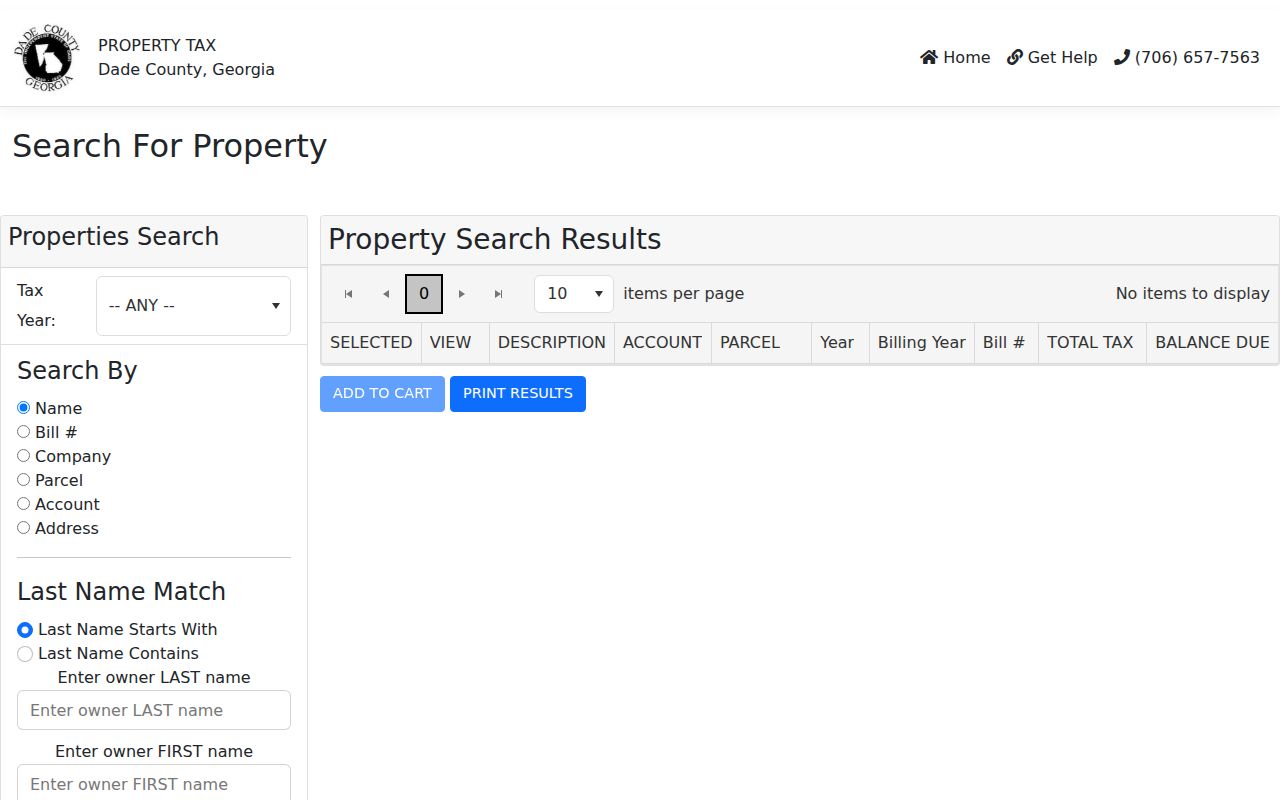
A search result can expose bill number, PIN, name, tax year, total tax, and balance due. It does not replace the assessor's appraisal record, which still governs value and exemptions in Dade County.
Follow a Dade County Tax Bill from Search to Status
Start with the bill portal when the question is how much was charged or paid. Work deliberately across the result. That habit keeps an old tax year, or a similarly named taxpayer, from being mistaken for the parcel you actually care about.
- Select the intended tax year and search AssuranceWeb by address or parcel.
- Confirm the PIN, account, taxpayer name, and address on the matching result.
- Read total tax and balance due, then check other available years separately.
- Compare value and exemptions on the assessor record; check official lien or tax-sale sources if delinquency matters.
- Assessed value
- The statutory portion of fair market value used in the tax process.
- Mill rate or levy
- The rate applied in calculating a tax charge.
- Homestead exemption
- Approved relief tied to an eligible primary residence.
- Tax lien
- A recorded claim arising from unpaid tax, distinct from a mere unpaid balance display.
Dade County Uses Georgia's 40 Percent Assessment Level
How does a county put a number on land? Dade County property tax records start with fair market value. The statute defines that through a willing, informed buyer and seller trading at arm's length. Assessed value then generally lands at 40% of that figure. The assessor may lean on market, cost, or income approaches. Each one works toward fair market value.
That 40% rule trips people up. A bill does not equal 40% of a sale price. Exemptions shrink the taxable figure first, and tax rates do the rest. The Dade County property value guide unpacks those numbers in more depth.
Dade County's own assessment page posts the local definitions and the process behind them.

Georgia assesses property each January 1. There is no fixed statewide revaluation cycle, so always note the year attached to any Dade County value before comparing it with another figure.
April 1 Matters for Dade County Exemptions
Dade County sets April 1 as the deadline for homestead and agricultural exemption applications. Homestead applicants should bring a current Georgia driver license. They should also bring a Dade County vehicle-registration receipt. Income-based exemptions also require proof of income.
The assessor's office hours are Monday through Thursday, 8 a.m. to 5 p.m. The office is open Friday, 8 a.m. to 2 p.m. Confirm the hours and document list before visiting. Eligibility depends on the exemption sought.
The Georgia Department of Revenue homestead page offers statewide context. The local assessor, though, accepts and decides every Dade County application.
Which Date Controls a Dade County Tax Record
Several dates on a Dade County tax record can all be correct at once. They belong to different stages. January 1 is the annual assessment date. The assessment notice starts the appeal period. The selected tax year controls the bill result. A payment date affects the balance, while a later filing date can affect a lien or tax deed.
| Date | Record it governs | Question it answers |
|---|---|---|
| January 1 | Annual assessment | When the property and value are considered for that year |
| Notice mailing date | Assessment notice | When the appeal clock begins |
| Tax year | Tax bill | Which annual charge the screen displays |
| Payment posting date | Collection account | When the balance changed |
A 2024 Dade County calendar listed a September 10 mailing, a November 15 due date, and a January 14 tax-sale levy. Those dates belonged to that calendar alone. Check the current year's schedule rather than carrying them forward.
Dade County Tax Sale Status Needs a Live Check
The official tax-sales page may show no scheduled sale. That is a current status rather than a forecast. Check the Tax Commissioner's tax-sales page directly. Then examine the bill, lien records, court filings, and any final deed for the parcel of concern.
A delinquent balance alone does not mean title changed hands. Levy, notice, sale, redemption, and later recorded instruments can each alter the outcome.
Note the tax year on every result. For a sound timeline, search the lien index. Inspect any court filing. Look for a later tax deed or redemption-related instrument. Each event carries its own legal effect. A payment screen can show collection status, but it cannot summarize the full sequence. A Dade County parcel may have traveled a long one.
Contest a Dade County Property Tax Assessment
Dade County's assessor handles written appeals after a notice of change goes out. Georgia gives owners a standard 45-day window. Count it from the mailing date on the notice. An owner can challenge the value itself, uniformity across similar parcels, taxability, or the denial of an exemption. Each route asks for supporting proof rather than opinion alone.
Build the case before filing. Pull the notice, the parcel number, photographs, and factual property details. Add comparable sales and a professional appraisal if one is available. Also include records of any condition the assessor may have missed. File with the Board of Tax Assessors using the instructions printed on the notice. Never file through the payment portal. The assessor review ends eventually. At that point the owner typically has 21 days to ask that an unresolved appeal move forward.
Keep proof of timely delivery and a full copy of everything filed. The Clerk's published fee schedule lists a $50 filing charge for a tax-assessment appeal in Superior Court. That later court route is separate from the first filing with the assessor. Confirm the forum, the form, and any charge before advancing a case.
Appeal window. File with the Dade County Board of Tax Assessors within 45 days of the notice mailing date, using the notice's current instructions.
Offline Routes for Dade County Property Tax Records
Sometimes qPublic blocks the browser. Or the bill portal returns no match. In either case, phone the assessor at 706-657-6341 for value and exemption questions. Use the Tax Commissioner's official contact for billing. Have the physical address, parcel or PIN, taxpayer name, and tax year ready. Ask for an existing record, not custom analysis.
A focused county request can go to 71 Case Avenue, Suite 243, P.O. Box 370, Trenton, GA 30752, or by email to info@dadecounty-ga.gov. Georgia law generally gives the first 15 minutes of search time without charge. Paper copies are ordinarily capped at $0.25 per page, with direct costs allowed on top. The custodian should produce the records within three business days or give a timetable.
Older tax questions may lead elsewhere too. The Georgia Archives holds the tax digests on microfilm. A digest is not a current bill. Still, it can document an older assessment entry. The live portal covers only recent years. Search the Archives county-record card catalog for Dade. Note the reel or volume citation. Then compare the name and land description against the corresponding deed period.